Category Archives: Ubuntu tips

Reinstalling and Fixing Grub 2 by NixiePixel

AddThis

Recovering the GRUB 2 Boot Loader by cgermany77

AddThis

How to manage the GRUB and purge old Kernel versions on the start-up menu

After a kernel update, you find the start-up menu populated with extra lines related to all the old kernel versions plus the current one. To manage the start-up manager and safely remove old kernels you have to manually operate on it.
First of all you have to double-check what is the current kernel version.
Open a Terminal and type:
uname -r
The result will be something similar to: 2.6.32-35-generic
Then you will go to the boot directory through the command:
cd /boot ls vmlinuz*
The next step will be to obtain more information about old kernel you have on our PC:
ls vmlinuz*
Now in the Terminal you have results similar to these:
vmlinuz-2.6.32-21-generic  vmlinuz-2.6.32-25-generic  vmlinuz-2.6.32-35-generic
vmlinuz-2.6.32-24-generic  vmlinuz-2.6.32-26-generic
As last step you have to remove all the old version of the kernel using this command:
sudo apt-get remove linux-image-X.X.XX-XX-generic
where “x” is the obsolete kernel version you want to purge. In my specific case the proper command line I used was:
sudo apt-get remove linux-image-2.6.32-21-generic linux-image-2.6.32-24-generic linux-image-2.6.32-25-generic linux-image-2.6.32-26-generic
Last but not least go to System –> Administration –> StartUp Manager (available for installation on Synaptics or on Ubuntu Software Center) and select your OS choice in the Default Operating System menu. That’s all! AddThis

How to correctly configure and use the Windows Network on Ubuntu 10.04 LTS

At the beginning it appeared as a no-solved mystery because in all the many posts I read, there were no effective solutions. On my Ubuntu 10.04 LTS I was no able to use the external hard disk I had connected to the LAN and every time I tried to mount it I only received this message: Unable to mount location – Failed to retrieve share list from server


In few words it was not possible to use the Windows Network and all the people with the same problem (which is specific for the Ubuntu 10.04) suggested to reconfigure Samba but all the configuration and scripts I tried were no effective to let me use the external hard disk.

At the end I found someone who talked about a possible firewall misconfiguration and I tried in many ways to bypass the situation using ufw commands and opening ports and services over the LAN:

$ sudo ufw status
[sudo] password for *****:
Status: active

To                                      Action            From
—                                        ——                —-
135,139,445/tcp           ALLOW       Anywhere (log)
137,138/udp                  ALLOW       Anywhere (log)
Samba                             ALLOW       Anywhere
192.168.0.3 Samba     ALLOW       10.0.0.0/8
10.0.0.0/8                    ALLOW       192.168.0.3 Samba

Unfortunately, every new permission I granted to Samba on my Firewall was not a real solution but when I tried to stop the Firewall (System –> Administration –> Firewall Configuration) using the default firewall manager, Ubuntu was able to find and work on the external hard disk.

For this reason I made some tests and found this solution:

1 – enter your router settings and find the list of the attached device

2 – find the name and the MAC address of the LAN device you want to connect to your PC

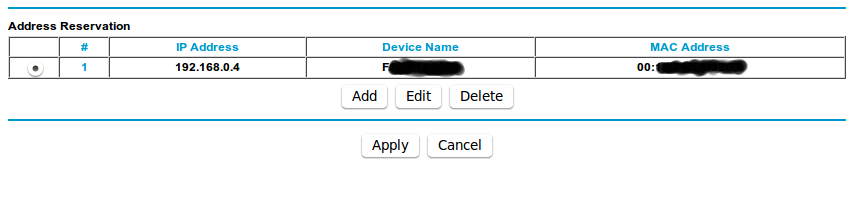
3 – find the menu for the Lan Setup and add an Address Reservation for the above device. Now you are sure that the router will always assign the same address to the device

4 – back to Ubuntu, install and launch Firestarter (for some incomprehensible reasons the default firewall manager is not able to create rules for Samba services and ports)

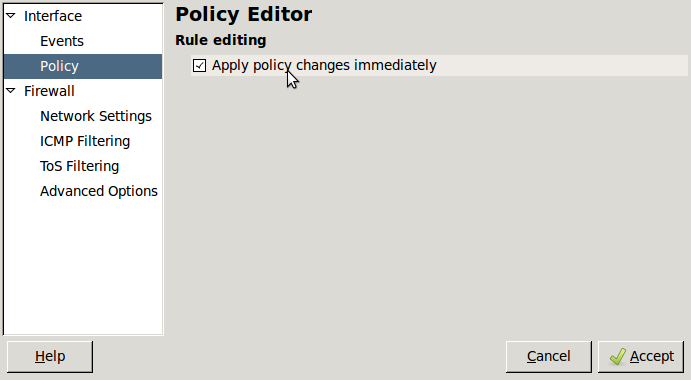
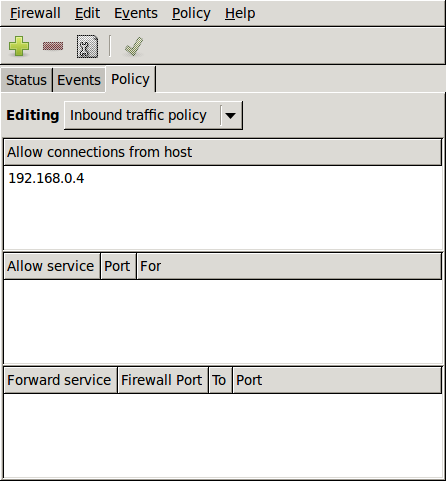
5 – on Firestarter, go to Preferences —> Policy Editor and click on “Apply policy changes immediately”

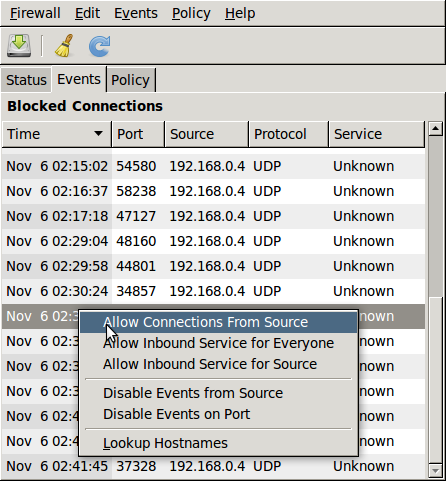
6 – try to connect again to Windows Network, obviously (sic) it will not work but then go to Firestarter —> Events and you will notice that the last line is the “missing” external disk which has an “unknown” service

7 – right-click the mouse on this line and “Allow connections from source”. Now the external hard disk is visible from Ubuntu 10.04 LTS and it is possible to work on it!

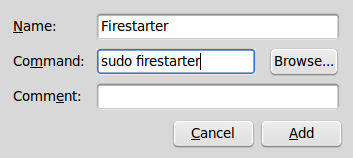
8 – to be sure that your LAN device will be rightly connected to Ubuntu 10.04 every time you boot up it: go to System –> Preferences –> Startup Applications

9 – add a new Firestarter rule typing the following command: sudo firestarter

That’s all! I hope you can find this post useful! AddThis

Video – Fix .ICEauthority by danny6465

AddThis

Fix .ICEauthority problem at Linux boot up

After upgrading my Ubuntu 10.04 LTS I had an error window at every boot up session. The message advised me about:

Could not update ICEauthority file /home/username/.ICEauthority

ICEauthority is the Inter-Client Exchange (ICE) Protocol that allows  authentication, negotiation, setting up and taking down connections between programs. In few words, if two programs have the same cookies, they will talk and exchange data through ICEauthority.

To fix this matter open the Terminal and type:

ls -al

Then you find a line similar to this:

-rw——-  1 root        root           35226 2011-10-06 00:24 .ICEauthority

This means that your profile (username on a Linux OS) is not allowed to manage ICEauthority and you have to gain full permission to solve the boot up problem:

sudo chown username:username ~/.ICEauthority

Where username is your user profile on Linux.

Then type:

sudo chmod u+rw ~/.ICEauthority

To check if you succeeded, type again:

ls -al

and this time you will find a line like this:

-rw——-  1 username username    35226 2011-10-06 00:24 .ICEauthority

That’s all! AddThis

Video – Compiz with Gnome Classic (Fallback Mode) – Ubuntu 11.10 by gotbletu

AddThis

Video – What makes Ubuntu 11.10 so great? (by celebrateubuntu)

AddThis

How To Install and Configure Conky by DarkJediHacker

AddThis

Install Conky system monitor for Linux and configure it in few basic steps

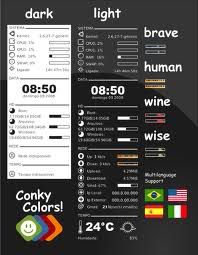
Conky is one of the most powerful and versatile system monitors for Linux desktops. It allows you to monitor and display all the information about your hardware, top processes, network, emails and more. At the moment more than 300 different feature has been built for Conky and searching on the web you always find the perfect feature already developed by someone.

– Installation on Ubuntu:

in Terminal run: sudo apt-get install conky

– Configuration:

In Terminal run: sudo nautilus

Go to File System: /etc/conky/conky.conf

Save a copy of the original conky.conf in another location and open the original file with Gedit Text Editor

First of all change: own_window yes to own_window no

Choose your preferred alignment (some samples below…):
alignment top_right
or
alignment middle_right
or
alignment bottom_right

Play with: update_interval 1.0
and change the interval value till you find the right ratio to obtain the best speed for you (in my case it was 0.80).

Add this line to eliminate any flickering:
double_buffer yes
but, on some computers, all the icon on your desktop will be hidden and you need to use (move) the mouse to discover them if you will not add this parameter: own_window_type normal

Add, as last line (or in other position if you prefer):
${color red} ${cpugraph} to have a clear graph about cpu (obviously you can choose the color you prefer)

For automatic start of Conky at startup, please follow the following instructions:
Run Startup Applications in System –> Preferences
Click on Add and save after updating the following instructions
Name: Conky
Command: /usr/bin/conky

Restart Ubuntu to check your new Conky “applet”

Link to Conky: http://conky.sourceforge.net/

For more info about Conky’s variables: http://conky.sourceforge.net/variables.html

Find online some pre-compiled Conky configuration files, searching, for example, on: http://gnome-look.org
AddThis