Category Archives: Technology

How to update Firefox to the 9.01 version on Ubuntu

If you use Ubuntu 10.04 or any other Linux distribution which doesn’t automatically upgrade your Firefox to the latest version you can force it.

First of all you have to launch Terminal and add the right PPA to the repository:

sudo add-apt-repository ppa:ubuntu-mozilla-security/ppa

Then you need to update and upgrade the OS using:

sudo apt-get update
sudo apt-get upgrade

If you are installing Firefox for the first time the right commands are:

sudo add-apt-repository ppa:ubuntu-mozilla-security/ppa

sudo apt-get updatesudo apt-get install firefox firefox-gnome-support
 firefox-locale-en

As usual on Linux, it is not necessary to reboot the computer and you can start immediately to use your updated Firefox. AddThis

How ro repair Ubuntu 10.04 LTS if the Update Manager and Synaptics don’t work

After I installed some new software I wasn’t able to update Ubuntu 10.04 LTS. The Update Manager was not able to check for updates and when I tried to use the Synaptic Package Manager I hadn’t better results. A reboot was not the right solution and I tested different ways to solve my problem saving the Ubuntu installation in my computer.

Searching on internet I discovered that there are few possible solution to avoid this problem and, in case you have the same bug on your computer, I decided to sum-up the most powerful after I successfully tried them.

First of all you can try to force the update process through the Terminal typing:

sudo apt-get update
sudo apt-get upgrade

If this doesn’t work you will try with this next step:

sudo rm var/lib/dpkg/lock
sudo dpkg --configure -a

Then launch again the Update Manager to verify if you succeed and if nothing happened solve the matter typing:

sudo rm /var/lib/apt/lists/* -vf
sudo apt-get update

and try again to launch the Update Manager.

In my case this was enough to restore all the Update Manager features and solve the problem. If you have extra problems about this bug or if you want to suggest alternative solutions, please, don’t hesitate to comment this post. AddThis

Time to clean-up! Ubuntu – Linux suggestions.

Christmas time is ending and today we really don’t know how many relatives used out computer for “just few minutes” or “to quickly (sic) check the emails”. In few words, our Linux PC could have been overstuffed with unwanted temporary files and we haven’t had time to update it. So, it’s time to clean-up!!

First of all I suggest to use BleachBit because, for my experience, it’s the most powerful software to clean temporary files, log files and unwanted traces on your computer. BleachBit is easy to use and, as we described in previous post, very effective.

Then we have to check if our system is really updated so we can use the usual ways as Synaptics Package Manager or quickly run a some simple commands through Terminal to update, upgrade and remove old packages or Kernel.

For this purpose I collected three simple commands and chained them in a single line:

sudo apt-get update && sudo apt-get upgrade
&& sudo apt-get autoremove

In this way you will be sure that you can start again to work on your Ubuntu as before the Christmas time! AddThis

How to extend your home wi-fi lan using the Airport Extreme when the Netgear router hasn’t a specific option for that

This is the situation: I have a Netgear wi-fi router which has not the option to extend the wi-fi lan and two rooms in my house where it was not possible to use computers or external hard disks due to the weak wi-fi signal in there. The other available stuff I have is an Apple Airport Extreme with the right features to extend the existing wi-fi lan.

After many different configuration tests I was not able to configure correctly the wi-fi lan to improve the signal and cover all my house. Then I decided to buy a couple of used powerline ethernet adapter for about 30.00 USD and I put one of them near the area I wanted to cover with my wi-fi lan.

Then I connected the Airport Extreme to the adapter located near the low signal area and I was able to solve my problem configuring the lan in this way:

1- I reserved a fixed IP on the Netgear router for the Airport Extreme and I added that specific IP in the DMZ list:

2- I put the Airport Extreme in the Bridge mode and chose Ethernet as data connection:

3 – I cloned the configuration of the Netgear wi-fi on the Airport Extreme. In particular I assigned to the new wi-fi lan the same broadcasting name to the main one:

4 – I restarted the Netgear router and I had a strong wi-fi signal into all my house.

I know that the solution I found it is not orthodox but it is cheap especially when you do not want to spend money for a new professional router when the “old” one is still brand new. AddThis

Multiboot CD /DVD and USB Builder: Sardu

The last generation of external 3.0 usb disks allows us to create fast multi-boot drive that can be used for different purpose. Commonly we use these “special” drives as recovery tools when something goes wrong in our computers or when we would dig, in a deeper way, a particular desktop.

The best software to create multi-boot disks or ISO have been developed for Windows and the only exception is a French, multi-step solution named LiveUSB Multi-Boot.

Today we focus our attention on Sardu a multi-language Italian project developed for Windows machines. After you have downloaded it you can unzip and save the folder in your favorite location. The sardu.exe file will run the program and you can start to decide if you prefer to create a multi-boot ISO or a multi-boot usb key.

The menus are complex but in a couple of minutes you will be able to properly navigate them and select the software and ISO you’d like to have in your CD or USB key. You can also decide to manually add a specific ISO which is not directly supported.
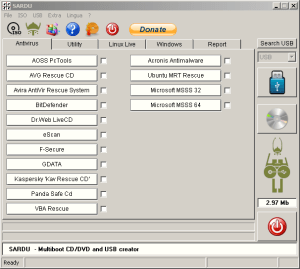
The CD-DVD burner is included in Sardu consequently you can create your bootable CD-DVD in just few clicks.

In the everyday world, Sardu is also useful to test computers when you want to quickly install a Linux distribution and you are not sure about the best one to choice.

Moreover, Sardu is plenty of extra freeware which can help you to recover the GRUB, partitions, lost files and passwords.

Unfortunately Wine is not able to run Sardu in a correct way and when we tested it on Ubuntu we were able to use just few basic features. AddThis

Sendoid: share your file through torrents

The first time I read about sendoid.com I was really interested about the services offered by this site. In fact, the possibility to share files with my friends regardless dimensions through a torrent protocol appeared to be very useful.

Unfortunately, in my personal experience the results are not so positive as promised by Sendoid.com. When you decide to try it, you can choose between the online version and the desktop widget built on the Adobe AIR technology. The widget installation is easy, graphically nice and simple to use. Furthermore, the online interface is very well structured in few clicks you are able to “build” the torrent url to share your file directly from you PC to other people through torrent protocols. For this reason, if you decide to use the online version, you are not allowed to close the webpage with the url because it is the “door” to keep the torrent working.

The first problem is that the data are not protected by https and you can only decide to add a password to your file. On the other hand, with just one click you can decide to share the file with more than a person.

The second, big, problem you have with Sendoid is the transfer speed because, in my tests, the service was not so competitive in terms of timing. A light 160MB ISO needed more than 20 minutes to complete its transfer from my computer to another located in a near city. Unfortunately I was not able to understand if this specific problem was related to the ISPs or to the sendoid service but I obtained the same results in different extra tests I decided to try with similar files.

To conclude I decided not to use sendoid and now I am looking for another program or website which could offer similar features. Please, if you have something to suggest, do not hesitate to add a comment! AddThis

Try Lib-Ray: “Sintel” Lib-Ray PROTOTYPE v0.2

The following text comes from: http://www.archive.org/details/sintelLib-rayPrototypeV0.2:

‘The Sintel PROTOTYPE of the Lib-Ray free/open fixed media format for high-definition video without DRM or other “anti-features”. Since it is a prototype, it comes with no guarantees about stability or compatibility, but it is best viewed using Google’s Chromium web browser in full-screen mode on a system with a 1920×1080 “full HD” screen. Some features do not yet work even on this configuration, however, as they require elements of HTML5 that are not yet implemented. Because it’s a short movie, the ISO is relatively small (2.1 GB), and it will fit easily onto an inexpensive single-layer DVD-R disk”.

More details about the project are also available from the Lib-Ray site: http://lib-ray.orgAddThis

A new multimedia open-source standard to replace DVD and Blu-Ray DRM limitations: Lib-Ray

At the beginning we astonished because the video quality on DVD was something of incredible. Then Blu-Ray destroyed all the standards we were used to enjoy while watching our movies. During last 7 years the home theatre industry has developed its standards in a geometric way but the DRM topics have increased our technical barrier between people who legitimately bought DVDs and Blu-Rays and the possibility of creating backup copies.

The war between DRM and hackers is absorbing. When a new standard of DRM has been developed we wait to know how much time will pass before someone can crack it. And it is only a matter of time because it is not technically possible to create the perfect barrier against multimedia supports when, by definition, the key to decrypt the files is somewhere in the disk or on the media player. During last years, the reverse engineering has increase the chances we have to deeply understand and rewrite proprietary software.

Lib-Ray is a “new” ambitious project to create a new open source multimedia standard which could be able to challenge DVD and Blu-Ray. The developers describe Lib-Ray as “multimedia website on a disk”. The manual you can download from Lib-Ray websites, describes in details all the structure you have to create on the disk for your files. Lib-Ray runs on java libraries and html5 structure and its framework is represented by Inkscape, Gimp, Audacity, xiph.org, Flac and code from Mozilla and Chromium.

In few words, you don’t need a specific hardware to run Lib-Ray disks but each computer with a Chromium browser and a bunch of open source software will be able to perfectly play your disks (as simple as genial!).

Last but not least, on the Lib-Ray website you will also find a Downloads page dedicated to dedicated manuals, libraries and one interesting template. AddThis

Gmail Plasmoid – Kubuntu 11.04 by gotbletu

AddThis

Best Gmail Notifier For Ubuntu Linux by Videoorchard

AddThis