Lubi is a useful tool for all people who like to experiment different Linux OS on their PCs. In particular Lubi has been thought to let you install Ubuntu in just few clicks and without risking annoying “secondary effects” on your computer. In our Linux Page (in Spanish) we have posted a small but effective review with all the necessary links to the Lubi project and we have also listed all the Linux OS (PCLinuxOS 2007 32-bit, openSUSE 10.2 32-bit, Gentoo 2007.0 32-bit, etc..) already tested for a safe -Lubi- use. We strongly recommend Lubi for all users who want to deeply test Ubuntu (and its features) without starting from the Live CD. 
Monthly Archives: July 2007
Neo 1973: the free, opensource, Linux based anti-IPhone!
Last July 9, the Openmoco Inc. (a Taiwanese company) launched Neo 1973 developer edition. Today, in our Linux Page we have posted a complete review about the main features contained in this quad band, GPRS enabled mobile. The consumer version is planned for next October and we hope there will be a decrease in its actual price (USD 300). The many features contained in this mobile are -more or less- the same that in the IPhone but the main difference is that Neo 1973 is based on 100% open source software and it can easily opened for any desired hardware modification (only if you are expert hackers). The 2.8″ VGA TFT color touchscreen display is a little bit smaller than in the IPhone but it is very clear and the images look sharp. Bluetooth 2.0, AGPS and a USB 1.1 port are integrated. Last but not least, Neo 1973 supports high quality audio codecs and a Micro SD slot which can be used to upgrade its default 128 MB RAM and 64 MB NAND Flash memory. 
How to extract archives (ACE, ARJ, CAB, CHM, CPIO, DEB, ISO, JAR, LZH, NSIS, OOo, PAK/PK3/PK4, PET/PUP, RAR, RPM, SLP, Z/TZ) and create many others in just few clicks: PeaZip!
Today, in our Linux Page (in Spanish) we have post a review about PeaZip: a terrific program which is able to solve many common problems when extracting certain types of archives such as ACE, ARJ, CAB, CHM, CPIO, ISO, Java archives (JAR, EAR, WAR), Linux installers (DEB, PET/PUP, RPM, SLP), LHA, LZH, Open Office file types, PAK/PK3/PK4, RAR, Windows installers (NSIS, some MSI), Z/TZ. This program was developed in two different versions: for Windows (XP and Vista) and for Linux. Moreover a powerful portable/standalone version (for both Windows and Linux) is available. Last but not least, using PeaZip you will be also able to create 7Z, 7Z-sfx, BZip2, GZip/TGZ, PAQ8F, PAQ8JD, PAQ8L, PEA, QUAD, split (.001), TAR, ZIP archives. In few words, PeaZip is tiny, extremely useful and easy to use program: strongly recommended! 
How to upgrade or repair your Macintosh or Ipod: a quick reference guide to useful websites!
Today, in our Freeware Page we have added a new (and very detailed) post with useful links to websites containing terrific instructions to upgrade or repair Ipod, Apple desktops and laptops. These websites can be useful for the people (like us) who do not desire to throw away their Macintosh only because a new model has been launched. Last but not least we have decided to insert also some links to websites which have Macintosh news and guides about regenerating old notebook batteries. If you have some more useful and free websites to suggest, please, write a comment! 
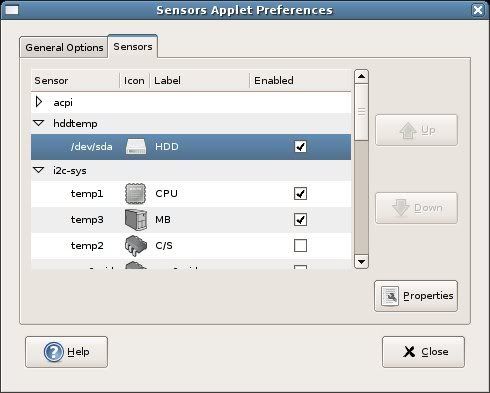
Gnome Sensors Applet (GSA): a -must have- applet for your hardware security in Gnome OS!
Today, in our Linux Page (in Spanish) we strongly suggest a very useful applet for every Gnome OS: GSA. The Gnome Sensors Applet let you constantly check the hardware sensors, including CPU temperature, fan speeds and voltage. GSA is very easy to install and manage; its intuitive graphical interface allow you to decide what alarms you prefer to display in case of emergency. GSA is recommended for all the Linux users who constantly push the limits of their pc.