Since this week, the Italian Authority for Communications, when a copyright violation is just reported (not proved by a Court as in all the other countries), can remove or inhibit any Italian or foreign website by blocking the IP address or the Domain Name Systems. This new regulation (not a law) actually represents a violation of the Net Neutrality.
Category Archives: Technology
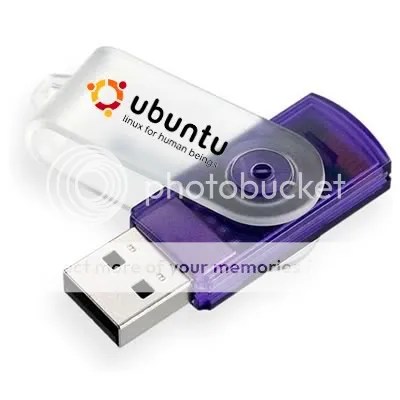
How to Boot Ubuntu from USB
When it comes to the most recent generation of computers, there is an option to start an operating system right from a USB stick, without an actual installation process. This may be an option to use or test a different operating system without affecting in any way the one that is already installed.
Starting from version 8.10, Ubuntu can be installed on a USB stick in a more easy way by every single user, regardless of their knowledge in Linux. To perform the installation, the user must have a version of 8.10 or later on CD and a USB stick with a capacity of at least 700 MB free space available, but this can vary according to the version of Ubuntu that you want to use for this process.
To install Ubuntu on the USB stick, you can simply boot the Live CD mode of Ubuntu or alternatively, if already installed on your on your system, you can follow the following simple procedure to do this, which is described in some basic steps below.
First of all, you need to access the Ubuntu menu bar, via System> Administration, choose Create a USB startup disk.
At this point, you will be asked to specify the source disk image of Ubuntu. If you have the Ubuntu CD in optical drive, it should appear in the list and will be selected. Otherwise, click Other and specify the location of the image. The .iso format will do it, but other versions may work as well.
When completed, you can use the stick on any computer that can boot from such units. Just tell the computer’s BIOS to use this option and restart the respective machine. The same procedure can be applied for the any distribution of Linux, so this is a helpful tutorial for everyone. 
CD Burning Applications for Ubuntu
There are not many applications for recording optical media under Linux. On the other hand, applications for Windows that allows a user to write a CD or DVD are numerous, but the most important difference is that those available on Linux are free and / or open source, with some exceptions. But all have basically the same purpose – to write or copy a disk.
In the world of Linux, the most common applications for burning optical media are usually pre-installed with the operating system chosen by the user. If not, they can be downloaded and installed easily on almost any platform.
Here are some of the most common such programs for Ubuntu:
Applications for Gnome / GTK
Brasero
Brasero is one of the most popular tools in the world of burning CDs. It usually comes pre-installed in most distributions that use Gnome. Brasero provides the user with a very friendly and simple interface while keeping all the important features needed by a user. Brasero is an application that requires minimal resources, providing maximum functionality, all integrated in one intuitive interface.
GnomeBaker
GnomeBaker is another GTK application with the same functionality as Brasero, but with a different interface. GnomeBaker gives the user an interface similar to Nero and K3B. The difference in use depends on the visual tastes.
X-CD-Roast
X-CD-Roast is an application to burn discs with its basic functions, but comes with a relatively primitive interface. Many users might find its interface as hard to use.
KDE Applications
K3B
K3B is probably one of the most popular programs available in the Linux world. It has many advanced features and options that would satisfy most users of such a program. It is available for both KDE and Gnome. Generally, K3B is regarded as the Nero of Linux.
Including a Ubuntu Machine into a Windows Domain
One of the great problems of interoperability between Linux and Windows has been the impossibility of Linux systems for joining a Microsoft Windows network. Subsequently, several standards to achieve this were developed over the years (see Samba), but they were far from offering normal user the chance to achieve this easily.
The infrastructure of many companies around the world, of all sizes, also relies on the use of a Windows domain. In all companies, one priority always stands out. That is to reduce information costs and expenses. Because of this, many of them have opted for the use of computers with Linux operating systems. But in many cases their integration into Active Directory environments was a problem.
Recently, a new tool was created to facilitate the full integration of a Linux system in an AD environment. And as far as today, it seems very promising. Thanks to likewise-Open5 (http://www.likewiseopen.org/), the difficulty of integration is almost null.
The following lines will illustrate the inclusion of Ubuntu in a Windows domain via likewise-Open5.
Installation
Likewise-Open5 Installation process is very simple. It can be done both through the graphical environment and command line. We will use the second variant. Therefore, a new terminal window must be open, in which you specify the following command:
sudo apt-get install likewise-open5
This command should resolve all the dependencies necessary to prepare the machine to be integrated in the Windows domain.
Adding a new machine
To actually add the machine, specify the following command in the terminal window:
sudo domainjoin-cli join domain used
Where DOMAIN is the area used for integrating the machine, and USER is the username that has the corresponding rights. You will be asked for your user password, and once successfully logged in, you are officially added the desired machine.

How to open PDF files (and other formats) through Mozplugger on Ubuntu
This article comes as a useful help for all Linux (Ubuntu) users, which will be presented with a new way of opening PDF files in the browsers compatible with this operating system. First of all, most of you probably know that Google Chrome is capable of doing this by default, without the user being required to make a particular setting.
However, Firefox does not currently have this built in feature, so it needs some help (usually in the form of a plugin) in order to open the PDF files you download or see online. In addition to the official plugin from Adobe (which contains numerous bugs and can sometimes be really annoying because if its way of loading PDFs), there is the option known under the name of Mozplugger. This is actually a plugin that allows the integration of different applications with the Firefox browser so that it can open some files not recognized automatically by default. If you want to install Mozplugger, the following simple steps are required and can be done by anyone.
After installing Mozzplugger, the following text muse be written in mozpluggerrc:
application / pdf: pdf: PDF file
application / x-pdf: pdf: PDF file
text / pdf: pdf: PDF file
text / x-pdf: pdf: PDF file
application / x-postscript: ps: PostScript file
application / postscript: ps: PostScript file
repeat noisy swallow (Evince) fill: Evince “$ file”
After making these changes, a restart is totally recommended. If you do not restart your browser right after that, changes might not take the desired effects. You will surely enjoy everything this great plugin has to offer. Not only will you be able to read PDFs directly in your browser, but there will also be some extra formats that you never thought they could be read directly from Firefox. 
How to Get Rid of the Root Password on Linux
If you are a Linux user, particularly Ubuntu, and are the only person that uses your computer, sometimes the fact that your operating system constantly requires for your password every time you log in, then at a certain moment you might want to decide to get rid of it. All you need to do is to follow the next steps carefully and you will be ready to go.
- Run a new terminal. This is essential, since, as you already know, every important command and feature of Ubuntu and Linux in general must be done in this way
- Run the command ‘sudo visudo’. This will at first require the current root password, as every line starting with ‘sudo’ does.
- Type the root password and hit return
- A new document will now open in your terminal, which will require some editing. Specifically, a new line should be added in the end of this document. This line is ‘username ALL=NOPASSWORD:ALL’. As you can guess, this will make your operating system stop asking about your root password every time you log in, regardless of the user you use for this process.
- Save the edited document and make sure the changes are active.
- Restart your computer and check to see whether you can log in without your root password.
As you can see, getting rid of the root password is a rather easy process and sometimes it will save you a lot of time. However, make sure you only do this if you are the only person who uses your account on your operating system, because otherwise your security will be exposed.
This password removal tweak will also work for ‘sudo’ commands as well, making it even simpler for you as a Linux user. 
Terminate unresponsive programs on Ubuntu
Xkill is part of the X11 utilities pre-installed in Ubuntu and a tool for terminating misbehaving X clients or unresponsive programs. You can easily add a shortcut key to launch xkill with the steps below:
– Go to System > Preferences > Keyboard Shortcuts.
– Click the Add button to create a custom shortcut.
– Enter xkill to both the Name and Command boxes and click the Apply button.
– Click on Disabled at the xkill row in the Keyboard Shortcuts window (Disabled is then changed to New shortcut…).
– Press a new key combination, e.g. Ctrl+Alt+X (New shortcut… is then changed to Ctrl+Alt+X).
– Click the Close button.
Xkill is ready for use. Press the above key combination to turn the cursor to an X-sign, move the X-sign and drop it into a program interface to terminate the unresponsive program, or cancel the X-sign with a right-click. 
Changing the default text editor on Ubuntu
There is a few software that will use the editor command to find out what text editor to use. Example commands will be dch to add a new .deb changelog entry, revision control softwares when prompting for commit a message …
There is basically 2 ways for changing the default editor:
1. System Wide
Run Terminal and type:
$ sudo update-alternatives –config editor
And then choose whichever editor you want to be default.
2. User Level
As a user, you cannot change the setting for the whole system, but you can add an alias for editor to let say vim.
Open and edit ~/.bashrc and add:
alias editor=vim
Next time you will open a bash prompt, your default editor will be vim. 
How to Install Inkscape on Linux (with special instructions for Ubuntu)
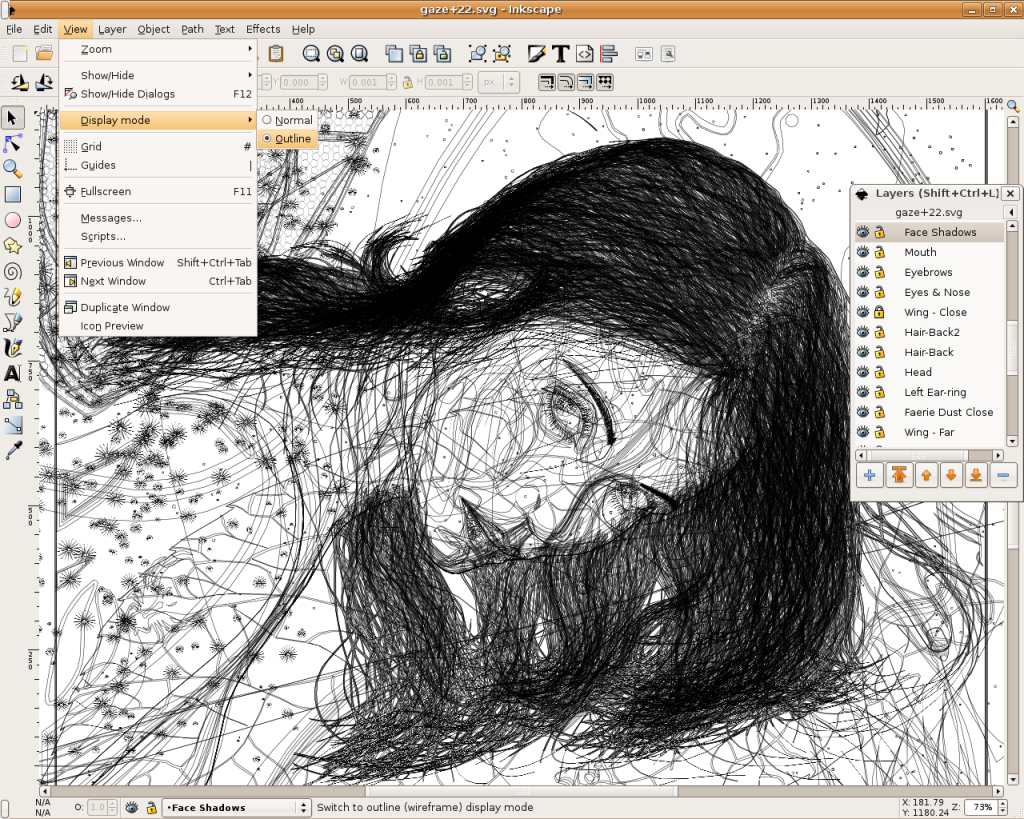
Inkscape is an open-source SVG editor with capabilities similar to Illustrator, CorelDraw, Visio, etc. Supported SVG features include basic shapes, paths, text, alpha blending, transforms, gradients, node editing, svg-to-png export, grouping, and more. Its main motivation is to provide the Open Source community with a fully XML, SVG, and CSS2 compliant SVG drawing tool.
These are the founding goals for Inkscape:
– Full SVG (plus XML, CSS2) compliance
– Core written in C/C++
– Gtk-based user interface following the standards set out in the GNOME Human Interface Guidelines (HIG)
– Emphasis on a small core and extensibility. Usually Inkscape’s extensions are always first-class so we can say “no” to features in the core without guilt.
– Open, community-oriented development processes
– Baseline is the Sodipodi Hydra codebase
Where a better solution cannot be found, default to the way Illustrator does it.
- Installing on Ubuntu Linux
Probably the easiest way to install on Ubuntu is to use the apt command.
Open a terminal and type;
sudo apt-get update (enter)
sudo apt-get install inkscape (enter)
- Ubuntu Linux Development Versions
As it approaches release, nightly i386 and AMD64 builds of the latest Inkscape development version are provided at http://ubuntu.cafuego.net. On that site, one should select the appropriate Ubuntu or Debian release, then the Inkscape link, and finally the provided package.

Recovering root password under Linux with single user mode
It happens sometime that you can’t remember root password. On Linux, recovering root password can be done by booting Linux under a specific mode: single user mode.
This tutorial will show how to boot Linux in single user mode when using GRUB and finally how to change root password.
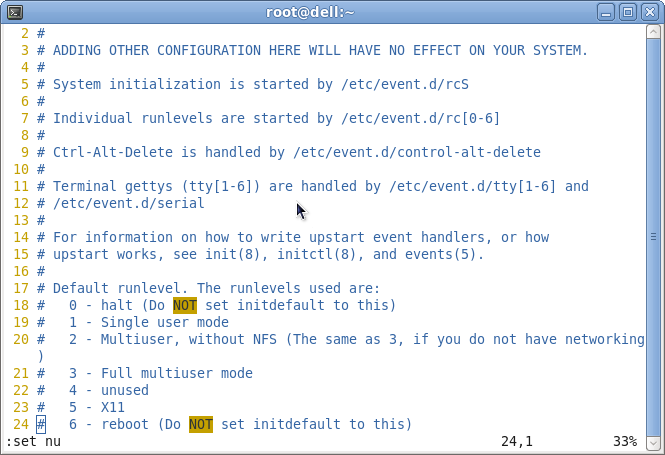
During normal usage, a Linux OS runs under runlevels between 2 and 5 which corresponds to various multi-user modes. Booting Linux under runlevel 1 will allow one to enter into a specific mode, single user mode. Under such a level, you directly get a root prompt. From there, changing root password is a piece of cake.
Some Linux distribution, such as Ubuntu for instance, offer a specific boot menu entry where it is stated “Recovery Mode” or “Single-User Mode“. If this is your case, selecting this menu entry will boot your machine into single user mode, you can carry on with the next part. If not, you might want to read this part.
Using GRUB, you can manually edit the proposed menu entry at boot time. To do so, when GRUB is presenting the menu list (you might need to press ESC first), follow those instructions:
– use the arrows to select the boot entry you want to modify.
– press e to edit the entry
– use the arrows to go to kernel line
– press e to edit this entry
– at the end of the line add the word: single
– press ESC to go back to the parent menu
– press b to boot this kernel
The kernel should be booting as usual (except for the graphical splash screen you might be used to), and you will finally get a root prompt (sh#).
Here we are, we have gained root access to the filesystem, let’s finally change the password.
As root, changing password does not ask for your old password, therefore running the command:
# passwd
will prompt you for your new password and will ask you to confirm it to make sure there is no typo.
That’s it, you can now reboot your box and gain root access again.