Category Archives: Technology

Precious Web reference to configure Ubuntu and mount Pogoplug as “local”disk

It’s a pity that Pogoplug dismissed its official application for Linux some years ago. It was really useful and easy to install. But, as usual, Linux geeks discovered how to solve the matter and mount Pogoplug drives as “local” disks on Linux. I already wrote about this topic in a previous post in 2012.

But recently, after I installed Ubuntu 14.04 LTS,  I had some problems with Pogoplug and I realized that the way I previously adopted was not able to mount Pogoplug as local disk. I searched on Internet and I found a good post  that is really self explicative about this topic. With a bunch of minutes I was able to connect again Pogoplug to my computer as local disk and, after some tests, I must say that the solution described by Linerd its really effective and stable. 

Good work Linerd!

References:

https://tuxtweaks.com/2013/06/mount-your-pogoplug-on-linux/

Pandora for “dummies”…. when you are outside the USA… – Firefox, Chrome and Opera add-on –

The last time I wrote a post about connecting to Pandora  when you are outside the USA was just (sic) three years ago. Meanwhile a lot of things changed and Anonymox, the Firefox add-on and proxy service I suggested in 2012, it is not free now.

It happens but when my nephew asked me something similar and really intuitive to connect to Pandora I was in trouble… more in trouble than I could imagine…. In fact when I started to search something alternative, I found a lot of very good proxy add-ons for Firefox. It was a pleasure to discover some of them because they are technically well done and offer a lot of flexible features for privacy purpose. But this is not the topic of my post… for today.

After many unlucky trials, where I tested different add-ons that were not able to guarantee a minimal rate of usable connection,  I found ProxMate .

ProxMate is an open-source, SSL proxy manager for real dummies. As Firefox add-on you can install it on your browser in just few clicks and then you practically don’t need to configure anything. The only requested thing after installation is to decide the websites and services you want to connect through ProxMate. The internet connection has a good speed rate and the music flows as silk through your Pandora account.

You can install ProxMate searching it through the add-on panel you find in Firefox or you can decide to directly open the link from the  ProxMate website. After the installation ( no restart required) you have to find the “shark fin” icon into your Firefox bar. If you don’t find it immediately, you have to manage your icons and manually personalize the bar.

Then, click on ProxMate “my button” icon and select: “Install New Packages”. You are redirect to the ProxMate website where you can select Pandora or others interesting websites (e.g. Netflix, iHeart Radio, etc..) with specific IP restriction policies. 

Now, you select your desired website/service and follow the instructions (click selection) that will appear on the screen to complete the installation.

Last but not least, don’t forget to click again on the ProxMate icon and enable the proxy service.

As usual, I recommend to NOT forget to disable  ProxMate (as every other proxy server) when you don’t need to use it.

Oops, I forgot to say that ProxMate is free of charge……. Enjoy it!!

——————

References:

https://addons.mozilla.org/it/firefox/addon/proxmate/?src=search

https://proxmate.me/

Link

War on Whistleblowers (ft. Edward Snowden & David Carr) 2015 • FULL DOCUMENTARY • BRAVE NEW FILM

Hibernate for Ubuntu

Since the Ubuntu 12.04 LTS the hibernate icon disappeared as possible option at the shutdown. It is not a big loss if you are not used to use (or overuse) it as I often do. Personally I think that the hibernate feature is really useful when you want to freeze your computer maintaining all the windows -and the work- you are working on at a precise moment. 

Ubuntu decided to “cut” this particular command from its GUI because it registered a remarkable number of problems caused by hardware conflicts in modern computers. 

If you use Ubuntu and you think that hibernate could till be useful for you (especially during busy working days), it is possible to insert again this specific feature as GUI on your Desktop.

First of all you have to test if your computer contains the right hardware for “hibernate” so open Terminal and type:

sudo pm-hibernate

The computer will hibernate itself but you have to reboot it to understand if hibernate worked properly in your case.

I hope (as it was for my PC) that all has gone well. In this case you can start to create the dedicated icon on your upper bar.

Before of starting it’s necessary to understand that the hibernate command will use the SWAP partition to save your temporarily data. Usually it is recommended to have a SWAP partition with, at least, the double of space of your RAM.

So I suggest to install Gparted to check the SWAP space and, only if necessary, increase your SWAP partition reducing the primary partition. Please, do this only after you safely backup all the data in your computer because this procedure could be risky if you are doing it for the first time and you have not enough experience:

sudo apt-get install gparted

Open a Terminal and install gedit and gksu (if you don’t have them already installed on your machine) typing:

sudo apt-get install gksu && sudo apt-get install gedit
Then type:
sudo gksu gedit /etc/polkit-1/localauthority/50-local.d/com.ubuntu.enable-hibernate.pkla
Now a blank gedit document, named enable-hibernate.pkla will appear on your screen.

Copy and paste the following text to “compile” it:

[Enable Hibernate]

Identity=unix-user:*

Action=org.freedesktop.upower.hibernate

ResultActive=yes

Save it and reboot your computer.

A new icon will appear on the right corner of the upper bar. When you click on it, a Terminal window will appear asking for the system password. Type it and click on Return and your PC will immediately hibernate. 

Good busy working days!

Link

Shape of the Web by Mozilla

Shape of the Web shows you where the Web stands today, the issues that impact it and what you can do to get involved.”

Blogilo: the Linux blog client to create new posts on your local computer

Yes, I know! Talking about Blogilo is not an hot news but the “recent” version 1.1 (according to the Help Menu in Blogilo software) has added some new features and something has changed. Some years ago, when I tested Blogilo, I thought that this software was a good “concept” but it lacked of too many features as compared with e.g. online WordPress.com platform. With version 1.1 these lacks have been reduced and now Blogilo becomes interesting if you are looking for a software that could be used daily for offline posting.
Blogilo now has less bugs than in the past and it is possible to write posts with just few seldom crashes. The user interface is intuitive and after the installation you spend just few minutes for adding and setting your blog. The positive thing is that Blogilo works with all the main blog platforms and it could be considered as one of the most complete blog client for Linux.
The matter is that blog platforms evolve quickly and Blogilo, as all its competitors, seems to be slower than many of them. In fact, it could happen that some up-to-date features are immediately not supported and you have to manually modify your post and adding them directly through the host website (e.g. WordPress). 
One of the most annoying problems I continue to have with Blogilo is about wrapping text around the image/picture I am used to put at the beginning of every post I write. It is a simple matter to solve but at every post I have to manually change the html code. 
As for my experience you have two different ways to solve this isssue.
The first is to edit the image/picture after you inserted it into the post and add the value “allign” selecting the right options in the Advanced Menu (why the Advanced Menu is not available when you insert a new image/picture?).
The second (faster) is to go to the Html Editor tag into Blogilo and add this code at the end of the image <img> tag:
align="left"
For example writing this post I added:
<img src="http://i119.photobucket.com/albums/o158/galigio/blogilo_logo_zps3pmqrnq1.png" align="left" width="160" height="105">
Simple to solve but really annoying when you have so little time to dedicate to your blog….
To sum up it is possible to affirm that Blogilo really contains all the features to write a blog but if you need something more professional you have to spend some hours, after the installation, to learn how to find the right solutions for your specific needs. 
———–
References:

Wireless Power Transmission: real available technology and marketing advantages

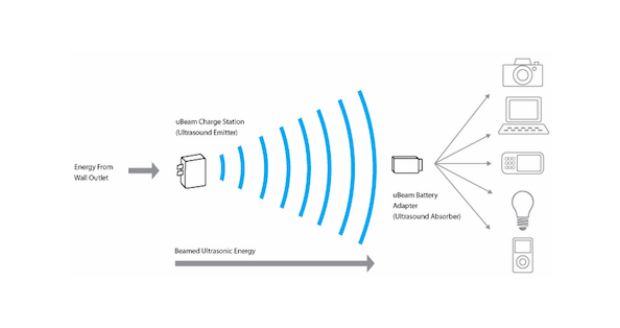
ubeamWireless energy transmission for remote charging is one of the most strategic key factor for the development of a new generation of tech devices in the near future. Few years ago some futuristic thinkers forecasted the possibility of wireless energy transmission between far places. In particular the academic community was interested in energy transmission between the planet earth and orbiting satellites equipped with solar power stations. 
This long range power transmission technology would radically change the energetic, economic and power equilibrium of our world but unfortunately, at the moment, this technology is not available. 
On the contrary, near range power transmission is something near the corner. 
After long researches an USA company  is launching the first generation commercial version of a wireless power transmitter with ultrasound that will allow to recharge (for the moment) mobile phones in a range of 15 feet (4.5 meters) just using a special cover. 
Fifteen feet are not a long range nor a medium one but the important thing is that it is contactless and that 15 feet start to be an interesting distance. 
So interesting that a big coffee shop chain as Starbucks  is considering to introduce these remote charging devices in all its shops. 
In this way all the customers will be able to automatically and freely charge their mobile devices as soon as they enter into the coffee shop. A good added value considering how much energy our devices need when strongly used during the day. And consequently, for many people, a good reason to prefer a store to another one. A potentially viral added value as well as a magnetic marketing strategy!
Last but not least, it must be considered that the success of this kind of technology operations is determined by costs. At the moment it is not possible to find any information about prices for the mobile device covers at the end consumer side. If the end users price for covers will be high, the huge, positive effects of a partnership with a big player as Starbucks couldn’t be enough without some kind of tech fashion pivot. 
Good luck uBeam! You have the right idea!
————–
References:

Update from Fedora 18 to 20 or 21 in few simple clicks and without (I hope) problems!

Fedora 21Sometimes simple things become hard problems. This happened to me when I discovered that my Fedora 18 OS was obsolete (very old indeed) and I tried to upgrade it to the Fedora 20 version.

Fedora 18 doesn’t support the automatic OS upgrade so I had to spend some hours to find information on Internet and create the right DIY solution for my case. At the end of my little (sic!) research I discovered that I was able not only able to upgrade the PC to Fedora 20 but I also found a good “trick” to upgrade to the latest Fedora 21 following in just a couple of steps with the help of fedup and some other escamotages.

This is how I succeed…

First, you have to open a Terminal and type:

su
init 3

but you will immediately leave the Fedora GUI and so it’s better if you write the below commands on an -old style, paper notepad- to be sure to have all the right information in you hands and correctly manage the upgrade from Fedora 18 to Fedora 20

sudo su -
yum update
yum install fedup
fedup-cli --network 20 --nogpgcheck

It’s better to add –nogpgcheck because often you are not able to complete your upgrade for the “old”, “bad saved” gpg key in your system.

reboot

Now, at the boot-up menu (GRUB 2 menu) you have to choose “System Upgrade (Fedup)”.

Then just to be sure you really have an up to date OS, in Terminal, type:

Yum update

If you have problems with one or more of your “old” repositories don’t forget to deconfigure them. In my case I had to launch this command line in Terminal due to skip an old repository and proceed with the upgrade:

yum-config-manager --save --setopt=home_moritzmolch_gencfsm.skip_if_unavailable=true

At this point, to upgrade from Fedora 20 to Fedora 21 you have to open (again) the Terminal and type:

su
fedup --network 21 --product=workstation --nogpgcheck

OR

fedup --network 21 --product=server --nogpgcheck

(if your Fedora version is the server one)

OR

fedup --network 21 --product=cloud --nogpgcheck

(for the Fedora cloud edition for generic virtual machines or Container)

Take it easy and go to bed for a long snap because, in my case, the download took some hours as for 2,577 files to be upgraded…

At the end, as before, you have to Reboot and select “System Upgrade (Fedup)” at the boot-up menu (GRUB 2 menu) and all the necessary files will be installed. Again, take a good book to read while you wait the installation.

Good luck and remind you MUST backup all your data before you start any upgrade because unforeseen risks are always around the corner!

References:

https://ask.fedoraproject.org/en/question/37247/upgrade-fedora-18-to-fedora-20-via-yum-or-fedup/

http://tecadmin.net/steps-to-upgrade-fedora-19-to-20-using-fedup-tool/

http://www.unixmen.com/upgrade-fedora-20-fedora-21-using-fedup/

https://ask.fedoraproject.org/en/question/39558/how-to-remove-a-repository-from-my-system

Teenagers are leaving Facebook. Why? Because their parents are on it. [The Guardian]

by Rob Beschizza.

This brief article is interesting because it analyzes a new trend between 16-18 years old EU citizens who prefer alternative social media to Facebook. Moreover, the article describes a new “mood” between young European who “feel embarrassed to even be associated with” Facebook because it is considerate a conservative choice strictly related to their parents relational behaviour. Something to reflect on over the new year!… Tempus fugit!  AddThis