 In the last days, I tested Google+ and it really works! It’s fast, well-organized with a really intuitive graphical interface and, for the “first time”, I was able to start conversations with different groups without worrying to say something inappropriate to the wrong person. The problem is that it wasn’t the very “first time” I had the possibility to share a conversation because, for some months, I was one of the testers of Diaspora, an open-source project, which was financed through kickstarter.com
Diaspora is a start-up project in its alpha release and the most interesting supported features are the https streaming and the possibility to create separate conversations with preselected groups. During the past months Diaspora has not grown fast but this kind of timeline is not unusual considering the number of developers involved, the financial capital used and all the different problems that a start-up has to solve during the first year of existence. The Diaspora’s real added value was the idea of a more secure social media through https and dedicated conversation shared between homogeneous groups of people.
On the contrary Google hasn’t had this kind of problems while developing a similar project, Google+. Anyway Google is so well structured and financially powerful that can reach the goals in a very short time if someone, at Mountain View, really believes on the future possibilities of a project. In few words, this is the natural dominance of a big player in an imperfect market where the start-up can be annihilated by a faster and richer competitor which is able to use more human resources and capitals.
I personally believe that Google, in such a way, has contaminated the natural software “diversity” growth and has too easily prevailed over the Diaspora’s guys. I am not talking about copyrights or trademarks which have often damaged the software development, I am talking about software evolution, the “natural” selection that allows small groups of people with better ideas to survive and prevail over the bigger companies. We cannot be sure that, after the completion of Diaspora, new valuable projects wouldn’t have springed from that team. Perhaps it’s time to critically ask ourselves if Google has become too big and too powerful over the web and if we need a new generation of laws or rules just to perimeter it (not to censure its works or split the company).
Back to Google+, I can strongly affirm that all the features I tested were well programmed and extremely intuitive to use. Moreover, Google+ integrates many other Google products (e.g. Picasa, YouTube, Voice, etc..) and you can share a lot of contents directly with the right people using the, now “famous”, Circles feature.
But at this point, we need another old -no software related- question mark. How many information about our lives are stored in Google servers? All the Google online software are successfully principally due to their high level of usability. None force you to use Google’s products, you are 100% free to decide but usually you have specific accounts to manage your photographs, favourite RSS, documents, phone directory, emails and now also your friends, family and more… All these information profile you and your personal attitudes better than ever. Using the right mathematical function, Google potentially has an accurate profile of you than no one else and sometime it is reasonable to believe that Google knows us better than we do.
In this prospective the “digital identification” card someone proposed some years ago to better regulate the web and check the people online activity, sounds prehistoric. The natural evolution of the net, connected to the lack of a real liberal regulation, has created a “nice” superpower company that potentially has the possibility to share our most intimate data with third parties influencing in a way or another our destinies. Can the privacy disclaimers we accept with each Google service protect our data in a bullet-proof way? Personally I have some little doubts!
On the other hand, during the last year we assisted to the dawn of more decentralized online services (www.yacy.net, www.faroo.com, www.majestic12.co.uk, etc..) and payment systems (www.bitcoin.org) which are able to guarantee a more efficient encrypted privacy. To extremely simplify the concept it is possible to say that these new technologies represent a possible future horizon that will be developed in few years. Consequently, it is reasonable to predict that two parallel Internet will exist in the near future.
The first is the logical evolution of the web we know today with a more “efficient” control developed by Governments and specialised “agencies”. The second will be something near to what we watched in the Matrix saga. A semi-secret Internet, developed by unknown “experts” where the privacy will be one of the most valuable elements and where we will use a new generation of dynamic encryption software. If we consider that nowadays it is technically possible to build low-cost telecommunication satellites, the only residual barrier for the creation of this new web is represented by the cost of the vectors to bring them into the space. Waiting for a cheap orbital launcher, new technologies have been experimented to build alternative webs. The transmission of encrypted computer data through the radio frequencies is one of the most interesting projects. But this is another story also because we should consider the risks related to a second new encrypted Internet if not used in a proper way…
To conclude, let me say that Google’s people are the best but now, it is time they start thinking a little bit less about online software or visionary technologies and much more about the potential social and freedom risks of their work. There are not precise rules about these topics because just few politicians have a real knowledge about the “digital frontier” and for this reason they have the terrific possibility to regulate themselves in the best way and be really transparent. History rules, when there is not effectiveness regulation, there is the risk that, sooner or later, lobbies persuade politicians to law in a wrong way. If we think about what happened in the last thirty years we can focus our attention on specific tragic events which allowed Parliaments to overreact and chain our civil rights and our privacy in a way that has not roots in our democratic societies.
On the contrary, with new democratic and “illuminated” rules or self-reforms, honestly created by real experts, there will less needs for a parallel Internet and perhaps the dawn of Morpheus’ era will be postponed for a while. At the moment we can only hope that Google people are not became too old to consider that they could change their point of view. The current Google technological path is just one of the many they can develop. Now this path seems to be efficient and, of course, profitable but perhaps the near future needs something different and less dangerous for our privacy and civil rights… (to be continued, sooner or later…). 

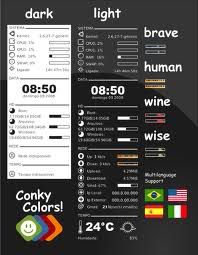 Conky is one of the most powerful and versatile system monitors for Linux desktops. It allows you to monitor and display all the information about your hardware, top processes, network, emails and more. At the moment more than 300 different feature has been built for Conky and searching on the web you always find the perfect feature already developed by someone.
 Desde hace unos meses
  Hace varios meses por fin pude conseguir un Móvil con
  Ante de nada, quiero disculparme con todos los seguidores de Galigio por la falta de Post en Castellano, espero poder volver a contribuir con mi granito de arena y compartir mis ideas. Bueno volviendo a lo nuestro, os quiero hablar del programa TeamViewer.

 icon in the Firefox Add-ons Manager, select “Install Add-on From File…” and follow the visual instructions.
 Computer Borders